Claude Code course comparison: 11 offers, checked prices

By Marco Kohns, Co-founder of ENLIX, lecturer in AI and growth
· 13 min read
A Claude Code course in German costs between 0 € and 7,500 € net, and the difference sits almost entirely in the format rather than the content. On 26 October 2026 we checked eleven offers on their own pages: the curricula of the open seminars overlap heavily, and with two providers they match down to the module order and the cent. So decide on three things rather than on a table of contents: how many taught hours you get, whether anyone works on your own code, and whether you have time to build between sessions.
This article is the price list for that decision, with two findings that explain it. We sell a course in this market ourselves, and our row sits in the same table as everyone else's, including the number that makes us look bad.
Which Claude Code courses exist in German?
Eleven, spread across five formats that are barely comparable with one another: a free self-paced course from the vendor, cheap video courses, open seminars of one to two days, a live cohort running several weeks, and the in-house course for a whole team.
| Provider | Format | Duration | Net price | Group |
|---|---|---|---|---|
| Anthropic Academy | Self-paced, English | 10 lessons plus a quiz | 0 € | none |
| Agentic Movers | Self-paced, German | 5 modules | 29 € basic, 49 € full access | none |
| enable-ai | Live online or in person | 1 day | 575.00 € | 3 to 10 |
| cmt | Munich or live online | 2 days, 09:00 to 16:00 | 1,090.00 € | max. 8 |
| kebel | In person or live online | 2 days, 09:00 to 16:00 | 1,090.00 € | up to 8 |
| Haufe Akademie | Online, Claude Code is module 6 of 6 | 2 days, 09:00 to 17:00 | 1,290.00 € | limited, number not stated |
| PC-COLLEGE (CL4) | 32 locations or online | 2 days, 09:00 to 16:00 | from 1,305.00 € | not stated |
| NobleProg | Online or classroom | 7 hours | 1,736 € online, 1,936 € classroom | not stated |
| ENLIX Academy | Live cohort | 4 weeks, 4 × 45 minutes live | on request | not published |
| Pexon Consulting | In house, on your repositories | 3 days | from 7,500 € | 10 to 15 |
| Synclaro | Coaching and group coaching | not fixed | no price published | not stated |
Two rows need a footnote before you compare them. Haufe Akademie does not sell a Claude Code seminar but a two-day Claude seminar in which Claude Code is the sixth of six modules. And the NobleProg price comes from the schedule for one announced session, not from a general price list.
Why do two providers charge the same price to the cent?
Because they sell the same seminar. cmt and kebel appear as two separate brands with separate websites, and their Claude Code foundation courses agree on every checkable point: 1,090.00 € net, 1,297.10 € gross, two days from 09:00 to 16:00, groups of up to eight, a certificate of attendance, and six modules in the same order whose titles are only lightly reworded.


The two module chains side by side, both copied from the respective page on 26 October 2026:
| # | cmt | kebel |
|---|---|---|
| 1 | Arbeitssetup und Steuerung von Claude Code | Arbeitssetup für Claude Code |
| 2 | Von der Idee zur prüfbaren Spezifikation | Von Idee zu Spezifikation |
| 3 | Design und Architektur mit klaren Leitplanken | Design und Architektur mit Leitplanken |
| 4 | Implementierung über Diffs und Review-Schleifen | Implementieren mit Review-Schleifen |
| 5 | Testen, Debuggen und Absichern | Testen, Debuggen, Absichern |
| 6 | Qualität im Team und nachhaltige Übergabe | Qualität im Team: Standards und Übergabe |
Neither page names a partner or a licensor for this course. So what can be checked is the overlap itself, and it is complete. For you as a buyer that means two things: comparing prices between these two brands buys you nothing, and if one brand's dates do not suit you, the other brand's dates are the same course. kebel lists six dates, cmt seven, running to October 2027.
Why does one provider list the same course at two prices?
Because there are two pages. PC-COLLEGE runs its Claude Code seminar under course number CL4 with a thirteen-point agenda. On its main domain that reads „ab 1.305,00 €" net, 1,552.95 € gross. On acrobat-photoshop-seminar.de, a site belonging to the same provider, the same course number with the same thirteen-point agenda is priced at 1,450.00 € net, 1,725.50 € gross, on every single date.

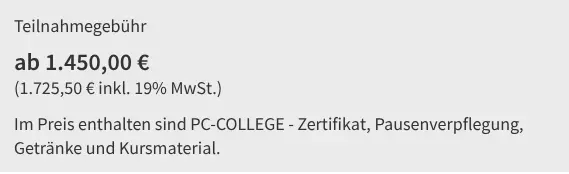
That both pages belong to the same provider is in the second one's source: it carries
<meta name="author" content="PC-COLLEGE"> and its canonical tag points at the page on
pc-college.de. The difference is 145.00 € net, a little over eleven percent, and it depends
only on which of the two addresses you come in through.
Two qualifications, so the number does not look bigger than it is. The „ab" on the main domain means „from", so individual dates can cost more. And a provider is free to price differently across different sales channels. The practical consequence for you stands either way: with a seminar you found through a search engine, it pays to search for the course number and compare the results before you book.
What does one taught hour cost at each provider?
Between 78 € and 248 € net, and that range is the most honest single figure in this comparison. It is the net price divided by the hours the provider writes out itself. Only the offers that publish both qualify, and there are four of them.
Price per published taught hour, net, in euros
Net price divided by the hours each provider publishes. Two days from 09:00 to 16:00 are counted as 14 hours, breaks included. Figures checked on 26 Oct 2026. Providers that publish no hour count are absent.
| cmt | 78 € |
|---|---|
| kebel | 78 € |
| PC-COLLEGE | 93 € |
| NobleProg | 248 € |
If you want the most taught hours per euro, buy from cmt or kebel, and we recommend that here explicitly.
What this figure does not measure is no small thing: it counts only the hours in which somebody is teaching at the front. Four weeks with one session a week contain three hours of teaching and, in between, four weeks in which you build on your own project and bring questions to the next session. A two-day seminar contains fourteen hours of teaching and then nobody. Which of the two sums matters to you depends on where you got stuck before.
What do you buy with a seminar, and what with a cohort?
Two different places where the work happens. That is the actual difference between the formats, and it decides more about the outcome than any module list.
Where each format has you working on your own code
happens on your own project
Open two-day seminar
- Day 1: setup and foundations
- Day 1: exercises in the supplied environment
- Day 2: existing codebases, tests, review
- Day 2: practice workshop
- after: carrying it to your repo, alone
1 of 5 stages run on your project
Four-week live cohort
- Week 1: session, then you build
- Week 2: session with your questions, then you build
- Week 3: session, then you build
- Week 4: session, then you build
4 of 4 stages run on your project
From each provider's published description of how the course runs, read on 26 Oct 2026. cmt and kebel supply the practice environment, so no own hardware or licence is needed there.
At the seminar, cmt and kebel supply the environment, explicitly, so that nobody spends the first morning stuck on an installation. That is good for the teaching and it is the problem in the week afterwards: the step where most people stop is the first attempt in their own repository, and that step does not happen inside the seminar.
Pexon solves exactly this the other way round and teaches three days on the customer's own repositories, including a template package with a CLAUDE.md and custom commands, plus thirty days of support afterwards. At 7,500 € and up it is by far the most expensive route, and for a team of five developers or more with an existing codebase it is still the shortest one.
Where does ENLIX Academy sit in this field?
At the bottom of the taught hours, with the price on request. Das Claude Code System runs four weeks with four live sessions of 45 minutes, assumes no prior knowledge, and gives twelve months of access to the course area and the materials. It is sold through Digistore24, which is therefore also the contracting party and the issuer of the invoice. At the end there is an ENLIX Academy certificate of attendance, which replaces no state qualification and no certification.
So we are not a developer seminar and do not want to be one. The open two-day courses address software developers, tech leads and QA roles, and they assume Git, code reviews and tests. Our course addresses people with no programming background who want to build a small system of their own, which is why from week 2 onwards it covers things that appear in none of the checked agendas: publishing a website, connecting Claude to the tools you already use, planning your own agents.
When you are in the wrong place with us: if you are a developer who has to roll Claude Code out across a team, if your employer is paying and you need a seminar with an invoice and a fixed date, or if you first want to find out whether the subject holds your interest at all. For that last case Anthropic's free course is the right answer and ours is not. One more thing worth saying plainly to an English-speaking reader: the cohort is taught in German, and the English course page carries a waiting list rather than a price, because no English cohort is scheduled.
Which course fits which situation?
It follows from what you already have and what you are missing. The table is the summary of this article and it replaces the question about the best course.
| Your situation | The format that fits | Why |
|---|---|---|
| You want to find out whether the subject holds you | Anthropic Academy, free | Ten lessons from the vendor, nothing at risk but your time |
| You learn alone and at your own pace | Self-paced course at 29 to 49 € | Cheapest route to a complete structure, with no fixed dates |
| You are a developer and want maximum teaching time | Open two-day seminar | 78 € an hour, environment supplied, certificate of attendance |
| You need a date and an invoice for your employer | Open seminar or live online workshop | Fixed dates, a clear invoice, groups of 8 to 10 |
| You have a team and a codebase rather than a project | In-house course | Taught on your repositories, not on a practice environment |
| You have your own plan and no programming background | Live cohort over several weeks | Time between sessions to get stuck on your own project and ask |
For what running Claude Code costs per month afterwards, our Claude Code cost calculator puts the plans against each other. What a path without any course looks like is in learn Claude Code, and the question of which tool to run at all is in Claude Code vs Cursor.
What is a Claude Code course, exactly?
A Claude Code course is training in the use of Claude Code, Anthropic's command-line tool, with which a language model reads, writes and runs commands directly inside a project folder. Four things are usually taught: the setup, writing project rules down in a CLAUDE.md, phrasing instructions, and checking the results through diffs, tests and reviews. A Claude Code course is not a regulated qualification, there is no protected award and no examination rules. What the providers issue are certificates of attendance.
And public funding?
Effectively ruled out for the German market, and one provider in this comparison writes that on its own page. For people in employment, § 82 (1) no. 4 of the German Social Code III requires a course longer than 120 hours, and nothing in this table comes close. On top of that sit the two accreditations a provider and the individual course both need. We are not AZAV-certified ourselves and hold no course accreditation for any programme, so a German Bildungsgutschein cannot be redeemed with us. The full two-minute check is in AI course funding in Germany.
If after all that you want to see our course from the inside: the curriculum, the dates and the price are published openly on the German page Das Claude Code System. And if this article sends you to another provider, it has done its job just as well.
Frequently asked
What does a Claude Code course cost?
The checked range runs from 0 € to 7,500 € net, and it says more about the format than about the quality. Anthropic's own “Claude Code in Action” is free, a German self-paced course costs 29 to 49 €, an open two-day seminar 1,090 to 1,450 € net, and an in-house course taught on your own repositories starts at 7,500 €. Every figure was checked on the provider's own page on 26 October 2026.
Which Claude Code course is the best one?
The question cannot be answered without knowing your situation, and anyone who answers it in general terms is selling you something at that moment. If you want the most taught hours per euro, an open two-day seminar at cmt or kebel is the better buy by arithmetic. If you first want to find out whether the subject holds your interest, take Anthropic's free course. If your team needs to be taught on its own repositories, an in-house course is the only format that does that.
Is there a free Claude Code course?
Yes. Anthropic runs “Claude Code in Action”, listed on its course page as “Register | FREE”, with ten lessons plus a quiz covering CLAUDE.md, permission modes, hooks and headless runs among other things. It is in English. For the question of whether you want to go further at all, it is the cheapest possible test.
Do the providers' curricula actually differ?
Less than the price list suggests. The open two-day seminars all cover the same chain: setup, project context in a CLAUDE.md, writing instructions, work on an existing codebase, tests, review and handover inside a team. Two providers sell the same six modules in the same order at a price identical to the cent. The differences sit in the format, the group size, and whether anyone works on your own code.
Can I take the ENLIX Academy course in English?
Not yet. Das Claude Code System is taught in German, with the price on request. The English course page carries a waiting list, because no English cohort is scheduled and we never sell an English speaker a seat in a German-language cohort. Everything else in this comparison is German-language too, with one exception: Anthropic's own free course is in English.

Marco worked as a growth product manager at a Silicon Valley scale-up and has been teaching that way of working ever since. Today he runs ENLIX with Tobias and builds two products of his own on the same systems, which is what the courses open up.
- Growth product manager at a Silicon Valley scale-up, Series A to B, backed by a16z, General Catalyst and Sapphire, with users in over 100 countries and more than 20,000 cities
- Peer-reviewed research in the Journal of Business Research on generative AI in growth, with Prof. René Bohnsack. The research began in summer 2022, months before ChatGPT was public
- Executive education lecturer at Católica-Lisbon, over 10 seminars, more than 1,500 people taught
Keep reading
How to learn Claude Code: four steps, in this order
Not the feature list, the learning order. Four steps with a stop criterion each, measured against the rules file that runs this website.
19 October 2026
Bildungsgutschein for AI Courses: What Actually Gets Funded
Germany's training voucher turns on two approvals, not on the subject. How to check them in two minutes, and what applies when a course fails.
23 October 2026
Claude Code vs Cursor: Which Fits the Way You Work?
The dividing line is not terminal versus editor. What actually decides it, with measured numbers from our own repositories.
18 September 2026