AI literacy obligation: what applies since July 2026

By Marco Kohns, Co-founder of ENLIX, lecturer in AI and growth
· 14 min read
The AI literacy obligation is Article 4 of the EU AI Act: organisations that use AI systems at work take measures to support the AI literacy of their staff and of the people working with AI on their behalf. Since 27 July 2026 a new, softer wording applies. No specific level of literacy has to be assured for anyone, no certificate is needed, and in Germany there is no fine of its own for Article 4. What remains: take measures and keep a record of what you did.
What sits inside that term, and which levels the German regulator and the European frameworks suggest for it, is covered in our article on AI literacy.
This article is the English version of our German guide, written for teams in Germany and the EU. Much of what ranks on google.de for the topic still reflects February 2025. On 13 October 2026 we read the 46 German pages on the first two result pages for the main search terms: 22 of them present the original wording of Article 4 as current law, and 11 mention the July 2026 amendment.
What is the AI literacy obligation?
The AI literacy obligation is the common name for Article 4 of the AI Act (Regulation (EU) 2024/1689). In the law the article is simply called "AI literacy" and requires providers and deployers of AI systems to support the AI literacy of the people working with those systems on their behalf.
The word "training" in the German nickname is a little misleading. Article 4 does not require training in any particular format. It requires measures, and training is the most common of them. The regulation defines AI literacy itself:
What changed on 27 July 2026?
On 27 July 2026, Regulation (EU) 2026/1744, the Digital Omnibus on AI, entered into force. It rewrote Article 4: an obligation to ensure a level became an obligation to support the development of literacy. Both versions of paragraph 1, verbatim:
| Original wording (2 February 2025 to 26 July 2026) | New wording (since 27 July 2026) |
|---|---|
| "Providers and deployers of AI systems shall take measures to ensure, to their best extent, a sufficient level of AI literacy of their staff and other persons dealing with the operation and use of AI systems on their behalf, taking into account their technical knowledge, experience, education and training and the context the AI systems are to be used in, and considering the persons or groups of persons on whom the AI systems are to be used." | "Providers and deployers of AI systems shall take measures to support the development of AI literacy of their staff and other persons dealing with the operation and use of AI systems on their behalf, taking into account their technical knowledge, experience, education and training and the context the AI systems are to be used in, and considering the persons or groups of persons on whom the AI systems are to be used. This obligation does not require providers or deployers to guarantee any specific level of AI literacy of any individual." |
Two things often said since then are wrong. The obligation was not abolished; it stays with organisations. And it was not moved to the state: on 19 November 2025 the Commission had proposed shifting it to the Commission and the Member States, who would only "encourage" organisations. The legislator did not adopt that. Both versions with all three paragraphs and the legislative steps are in our article on Article 4 of the EU AI Act.
The AI literacy obligation: the dates that matter
changes something for your organisation
Legal status
- 2 February 2025: Article 4 applies, original wording
- 19 November 2025: Commission proposes an amendment
- 27 July 2026: new wording of Article 4 in force
- 29 July 2026: German KI-MIG in force, Bundesnetzagentur responsible
- from August 2026: national supervision begins
- 2 December 2027: duties for Annex III high-risk AI
2 of 6 points affect you directly
What you do with it
- take measures on AI literacy
- update documents that quote the old wording
- keep an internal record of trainings
- refresh when tools change
4 of 4 points affect you directly
Dates from Official Journals L 2024/1689 and L 2026/1744, the KI-MIG (BGBl. 2026 I Nr. 223) and the Commission Q&A. The Q&A gives two different days for the start of supervision, so only the month is shown.
Who is affected by the AI literacy obligation?
All providers and deployers of AI systems. Under Article 3(4) of the AI Act, a deployer is anyone "using an AI system under its authority except where the AI system is used in the course of a personal non-professional activity". Anyone using AI at work is therefore a deployer, whatever the sector or size.
That includes the most common office case. In its Q&A, the European Commission answers whether a company whose staff use ChatGPT for advertising copy or translation has to comply with Article 4 with yes: staff should be informed about the specific risks, for example hallucination. There is no exception for organisations below a certain size, and the article is not limited to high-risk AI or to developers.
Whether and how the rule fits one particular organisation is a question for its legal advice. For the vast majority of organisations where people work with AI tools, the answer follows plainly from the wording of the regulation.
Does the obligation cover freelancers and external service providers?
Besides the organisation's own staff, Article 4 names "other persons" dealing with AI systems on the organisation's behalf. The Commission explains this in its Q&A with examples: persons broadly under the organisational remit who are not employees, such as "a contractor, a service provider, a client". The Bundesnetzagentur names contractors and service providers too.
In practice: if freelancers use AI tools for your organisation, include them in the measures and in the record. The simplest way is the same AI policy and the same register as for your own team.
Is there a fine if staff are not trained?
No, not in Germany, as of October 2026. The AI Act sets its fines in Article 99, and Article 4 is not listed there. Member States can set their own sanctions, and Germany did so with the KI-MIG, in force since 29 July 2026, but not for Article 4. Its section 15 names Articles 21, 27, 45 and 86 of the AI Act and does not name Article 4.
The figures often quoted come from other paragraphs. Up to 35 million euros or 7 percent of turnover apply under Article 99(3) to prohibited practices under Article 5, not to missing training. Up to 15 million euros or 3 percent apply under Article 99(4) to a list of other obligations, and Article 4 is not on it. In our sample, at least 4 of the 46 pages name sanctions for missing AI literacy that the law does not provide for Article 4.
Maximum amounts under the AI Act and the KI-MIG, in million euros, none for Article 4
Art. 5: prohibited AI practices (Article 99(3)). Art. 99(4): obligations incl. Articles 16, 26 and 50. Incorrect info: to authorities (Article 99(5)). KI-MIG s. 15: Articles 21, 27, 45 and 86. For companies, Article 99 alternatively sets a share of worldwide annual turnover, and the lower amount for SMEs. Checked on 13 October 2026.
| Art. 5 (prohibited) | 35 m € |
|---|---|
| Art. 99(4) | 15 m € |
| Incorrect info | 7.5 m € |
| KI-MIG s. 15 | 0.05 m € |
| Article 4 | 0 m € |
That does not make Article 4 toothless. The Bundesnetzagentur has supervised since August 2026 and writes on its AI literacy page that a lack of AI literacy can be regarded as a breach of the duty of care, especially when damage results. The Commission describes the same risk from the other side in its Q&A: someone who suffers harm and attributes it to missing AI literacy can sue. In both cases, a documented record is what you can show.
46 German pages on the AI literacy obligation, checked on 13 October 2026
Old wording: presents the version until 26 July 2026 as current law. Amendment named: mentions the July 2026 rewrite. KI-MIG or BNetzA: names the German law or the supervisor. Fully current: correct on every point checked. Wrong sanction: names sanctions that do not exist for Article 4. First 20 results on google.de for four German search terms, excluding authorities and statute texts; 5 of the 46 pages do not cover the obligation itself. Our own analysis, method below.
| Old wording | 22 pages |
|---|---|
| Amendment named | 11 pages |
| KI-MIG or BNetzA | 9 pages |
| Fully current | 8 pages |
| Wrong sanction | 4 pages |
Do staff need a certificate?
No. The European Commission's Q&A answers the question in one sentence:

The Bundesnetzagentur goes further and lists what Article 4 does not require, namely a guaranteed level of competence for individuals, formalised or standardised training, external certification of the measures, and an AI officer.
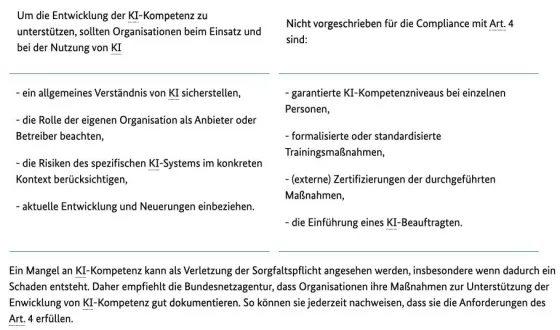
A course completion record can still be useful as evidence of what someone learned. It is not a precondition, though, and neither the regulation nor the KI-MIG provides for an official document for Article 4.
What do organisations have to do?
The Commission names four steps in its Q&A that organisations should consider at least. The Bundesnetzagentur sums up the same in three working steps: assess the need, design measures, then document, evaluate and refresh. Combined:
| Step | What you do | Tool |
|---|---|---|
| 1. Ensure a general understanding of AI | Basics for everyone who uses AI tools: how language models work, where they go wrong | The AI literacy test shows the gaps |
| 2. Consider your role | Do you use AI built by others (deployer) or offer your own (provider)? | |
| 3. Consider the risk of the systems | Which tools, for which tasks, with which data | AI policy generator |
| 4. Build measures on that, and record them | Training by role and prior knowledge, then a record | AI training record |
The Commission adds a point that matters for the format: simply relying on instructions for use, or asking staff to read them, might be ineffective in many cases. Neither the Q&A nor the Bundesnetzagentur requires an AI officer.
How do you document AI training?
With an internal record carrying the points the Bundesnetzagentur recommends: the type of measure, its content and duration, and the people who took part. No form is prescribed. A record that also names the date, who delivered it, the AI systems covered and the planned refresher answers any follow-up question without digging.
Our AI training record generator creates exactly that record from your entries, as PDF, Word file or Excel register. It runs in your browser, so participants' names never leave your device. Where the record belongs is set out in section 7 of an AI policy, which you can set up with the AI policy generator.
What should AI literacy training cover?
Article 4 prescribes no content but asks you to take into account technical knowledge, experience and the context of use, so one session for everyone rarely fits. As a planning aid, not a legal requirement, we have put together content and duration by role, which the generator applies:
| Group | Content | Our suggested duration |
|---|---|---|
| Everyone who uses AI tools day to day | Basics, risks, data protection, internal rules | 90 minutes |
| Managers and owners | plus the organisation's role, human review | 120 minutes |
| Teams that use AI regularly | plus hands-on practice with the tools in use | 180 minutes |
| Staff in customer contact | plus transparency towards customers | 120 minutes |
| Development, IT and data teams | all eight content blocks | 240 minutes |
For a team with 2 managers, 6 people in specialist roles and 4 in customer contact, that adds up to 30 hours of training time, which also sits far below the more than 120 hours German employment law sets as a minimum before publicly funded training of employed staff comes into question at all; the thresholds are in what actually gets funded. The calculation is in the training plan by role. The content that sets the floor for most offices comes from the Commission itself: people who use ChatGPT for texts should know about hallucinations. How to ask for answers in a way that makes them checkable is covered in our article on prompt engineering.
Does a works council have a say in AI training?
In Germany, where there is a works council, AI training touches two provisions of the Works Constitution Act. Section 98(1) BetrVG gives the works council a right of co-determination in carrying out workplace vocational training measures. Section 87(1) no. 6 BetrVG gives it a right of co-determination over introducing and using technical equipment designed to monitor employees' behaviour or performance. Many AI tools log who enters what, which is why that provision is worth a look when tools are introduced.
Whether a particular training or tool falls under these provisions depends on the case and belongs in the conversation with the works council or in legal advice. In practice, involving the works council early helps, because policy, tools and training are introduced together anyway.
How often does the training have to be refreshed?
Article 4 sets no cycle. The Bundesnetzagentur lists refreshing as part of its third step. In practice there is almost always an occasion: a new tool, a new internal rule, a new role, or an incident. Without one, a fixed date twelve months out keeps the topic from slipping. The record generator puts that date on the record.
How we checked the 46 pages
On 13 October 2026 we collected the first 20 results on google.de for four German search terms (ki schulungspflicht, ki kompetenz, ki schulungspflicht nachweis and ki verordnung artikel 4) and removed duplicates. We excluded texts by authorities and pure statute texts, because they are the source rather than the interpretation. We read the remaining 46 pages one by one and noted for each whether it presents the original wording as current law, whether it names sanctions for Article 4 that do not exist, whether it claims a certificate is needed when none is, whether it mentions the July 2026 amendment, and whether it names the KI-MIG or the Bundesnetzagentur as supervisor. For every hit we saved the quote.
A page that mentions the Omnibus only as a pending procedure counts as not up to date. Five of the 46 pages do not cover the obligation itself; of the remaining 41, 22 present the original wording. The results come from a logged-in browser and are a sample, not a ranking report. We do not name individual pages, because many were accurate when written in 2025 and have not been updated since.
Frequently asked
Has the AI literacy obligation been abolished?
No. Regulation (EU) 2026/1744 rewrote Article 4 on 27 July 2026, and the obligation stays with providers and deployers of AI systems. They take measures to support the development of their people's AI literacy. What is gone is the target of a specific level. The Commission's proposal to move the obligation to the Member States was not adopted.
Since when does the AI literacy obligation apply?
Article 4 has applied since 2 February 2025. The new wording has applied since 27 July 2026. National authorities have supervised compliance since August 2026, in Germany the Bundesnetzagentur under the KI-MIG.
Is there a fine if staff are not trained?
Not in Germany, as of October 2026. Article 99 of the AI Act does not list Article 4, and neither does section 15 of the German KI-MIG. The Bundesnetzagentur points out, however, that missing AI literacy can count as a breach of the duty of care, especially when damage results.
Do staff need a certificate?
No. The European Commission's Q&A says there is no need for a certificate and organisations can keep an internal record of trainings. The Bundesnetzagentur explicitly lists external certification among the things Article 4 does not require.
Is an e-learning course enough for the AI literacy obligation?
Article 4 prescribes no format. The Commission warns, though, that in many cases simply relying on instructions for use or asking staff to read them might be ineffective. An e-learning course can be one part, if it covers the risks of the tools you actually use.

Marco worked as a growth product manager at a Silicon Valley scale-up and has been teaching that way of working ever since. Today he runs ENLIX with Tobias and builds two products of his own on the same systems, which is what the courses open up.
- Growth product manager at a Silicon Valley scale-up, Series A to B, backed by a16z, General Catalyst and Sapphire, with users in over 100 countries and more than 20,000 cities
- Peer-reviewed research in the Journal of Business Research on generative AI in growth, with Prof. René Bohnsack. The research began in summer 2022, months before ChatGPT was public
- Executive education lecturer at Católica-Lisbon, over 10 seminars, more than 1,500 people taught
Keep reading
EU AI Act Article 4: original and new wording
Article 4 of the EU AI Act verbatim: the original wording and the version in force since 27 July 2026, every change, the procedure and what follows.
13 October 2026
Prompt Engineering: the four blocks of a good brief
The wording is not what decides it. Context and limits are. Anthropic's own guide, counted against a system we actually run.
7 October 2026
What is a prompt? The definition and what really arrives
A prompt is the input you give an AI model to set it a task. What goes in it, what the model reads besides it, and where the word comes from.
9 October 2026